Auditory alarms carry across the room. Mute and silence controls are at hand. The clinician can intervene directly on the patient and device.
02 Selected work / Mural
Enterprise healthcare · Remote critical care
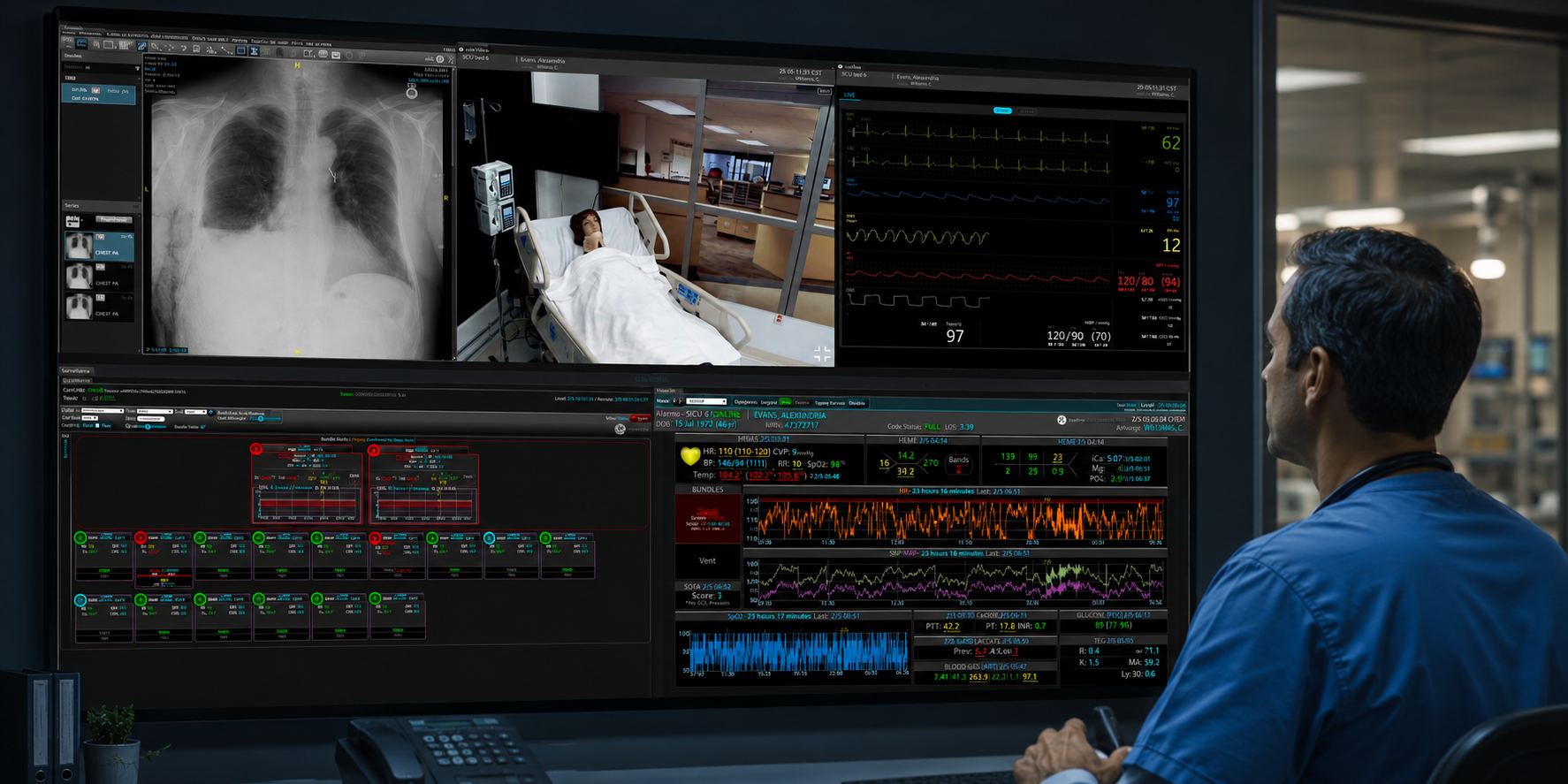
Many patients in view. One clinician at a distance. AI-generated illustrative reconstruction.
Tele-Critical Care Platform
Mural.
A remote-ICU platform for one clinician holding the state of a whole unit.
The defining constraint: they can see the bedside, but they cannot touch it. They observe, assess and escalate to the team standing next to the patient.
01
The governing distinction
Remote≠bedside.
Almost every interaction question resolved against this frame. Mural is not for the nurse inside the ICU. It is for a clinician elsewhere, whose power is intentionally limited.
No auditory alarm and nothing local to silence. The system differentiates visually; the clinician calls the bedside team. Mural never acts on the device.
This is a remote ICU. It is not for the nurses who are inside the ICU and next to the patient.
02
The Clinical Viewer
A canvas,
not a monitor.
The name describes the product: many different views of a patient composed into one consolidated clinical picture.
Mural brings live vitals, full disclosure and history, clinical notes, imaging, and a live two-way video link to the bedside into the application a remote clinician lives inside.
I inherited Mural as my first assignment in clinical software after the previous designer left. The Clinical Viewer ran on a laptop at a station—deliberately not a connected bedside device. That fact governed almost everything.
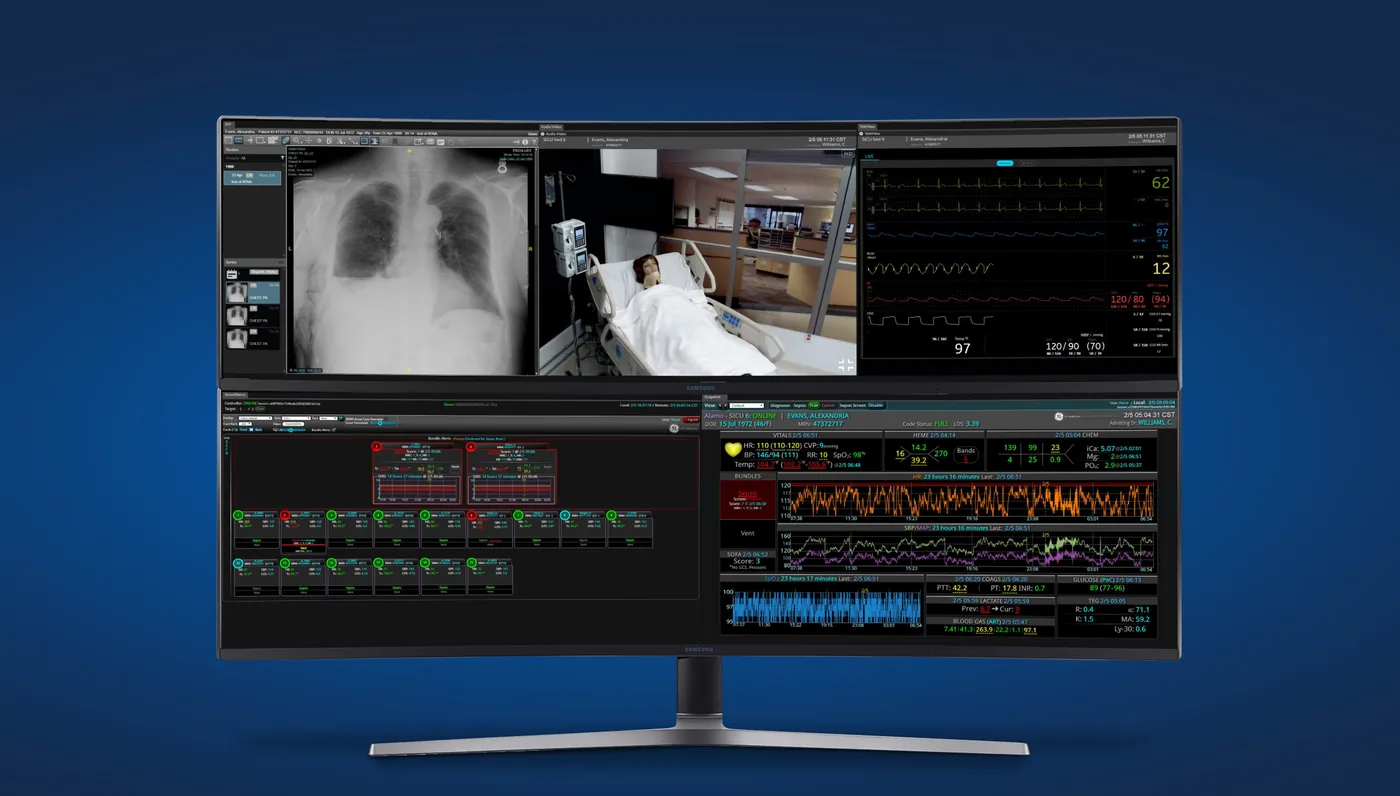
Imaging, live audio/video, waveforms, unit-wide surveillance and a patient snapshot, composed in one view. Public product brochure.
“It’s called Mural because it was like a canvas where you have different views, and you can put together a consolidated view of a patient.”
03
The multi-patient field
Many patients.
One attention.
A station watching many patients is at risk of drowning in alerts. The design problem was not how to show alarms. It was how to keep a fixed clinical signal meaningful across the field.
One care unit · sixteen beds
ICU-01
ICU-02
ICU-03MED
ICU-04
ICU-05
ICU-06HIGH
ICU-07
ICU-08
ICU-09
ICU-10HIGH
ICU-11
ICU-12
ICU-13
ICU-14
ICU-15
ICU-16
Baseline. Two alarms active out of sixteen beds—the realistic load Mural was tuned for, not the rare case where everything alarms at once.
Severity is fixed.
High, medium, low and informational levels come from medical authorities under IEC logic; they are not the designer’s to invent.
Difference is designed.
Mural uses colour, icon, blink and aggregation. Alarms clear when vitals return to range; they are never “acknowledged.”
Rotate, don’t compete.
Concurrent high-severity alarms auto-rotate rather than fighting for one position. Select High above to see the emphasis move.
History cannot become a parallel record.
Under the live field sits full disclosure: the complete record since admission. Clinicians annotate ECGs and take notes as timeline events, with multiple interpretations allowed to coexist. I later re-architected notes to sync bidirectionally with the EMR, so what a remote clinician records becomes part of the patient’s actual record.
04
Custom layouts
One default
isn’t enough.
A cardiologist and a respiratory specialist can look at the same patient and need a different first view. Forcing both through one layout is not neutral. It is less safe.
Mural loads a sensible default, then lets each clinician customise the arrangement to their role in two clicks and remembers it next time.
Customisation here is not cosmetic personalisation. It is a safety argument: the right information for the right specialist, without hunting for it. Product and UX made the architectural call together after research.
Patient snapshotPrioritised for cardiology
05
Attention narrows
Where should
the eye go next?
The wider platform screens patients across a unit, hospital or network against established early-warning scores—NEWS, MEWS and SIRS—to surface deterioration and pull a remote clinician toward it first.
Monitoring is the visible layer. Underneath it is triage.
The scarce resource isn’t screen space.
It’s attention.
Observe the field
Detect change
Prioritise risk
Escalate
Remote clinician looks here firstICU-06
Role boundaryBedside acts
The intervention happens where Mural cannot reach.
06
The through-line
A supervision pattern,
before I had the word.
Mural taught me that a single, well-chosen constraint can do more design work than a hundred screens. “Remote, not bedside” is a statement about roles in a system: who may act, who may only observe and escalate, and how an interface should behave when its user’s power is intentionally limited.
That is the same question I now work on with autonomous systems. A remote clinician watching an ICU they cannot touch is not far from a human supervising an agent acting on their behalf. In both, the design job is to make the situation legible enough that the supervisor can decide, in time, whether to intervene.
Next case study
← Previous · CareLogic